Wild Life

Feel the wondering variety of wild life and bio diversity in this little island

Surfing

Arugam Bay in east cost of Sri lanka is the one of best places in earth for surfing.

White Water Rafting

The small town of Kitulgala in the hill country is the most famous whitewater rafting location in Sri Lanka.

Goldi Sand Beaches

Experience the Miracle Beaches

Cultural Events

Kendy Perahara

Showing posts with label Safari. Show all posts

Saturday, October 20, 2012

Minneriya National Park

Minneriya National Park is situated in the north-central plains of Sri Lanka, 20 kilometers from Polonnaruwa. Even though it is one of the smallest national parks in the country, covering just 8,889 hectares, it’s a paradise with many natural wonders. The park encompasses the beautiful Minneriya tank, built by King Mahasena (in 3rd century AD). This tank is an incredible place to observe the elephants that come to bathe and graze on the grasses as well as the huge flocks of birds (cormorants, painted storks, open-bills, Pelicans and many other species of waders) that come to fish in the shallow waters.

Getting There

Main entrance of Minneriya National park is located facing Habarana – Polonnaruwa road (A11). From Colombo reach Habarana junction via Kurunegala, Dambulla (A1, A6), and take the right turn from Habarana towards Polonnaruwa. Drive 10 km towards Polonnaruwa to reach Minneriya National Park. Distance from Colombo is around 182km and total driving time will be around 4-5 hours.

Weather and Season

Best months to visit Minneriya are the dry months from June to September. Hundreds of elephants from the surrounding area are attracted to the drying Minneriya lake bed, which turns in to a lush green grass land, for food and water. Generally you can observe around five to ten herds of elephants, each with anything from twenty to fifty individuals of all age groups.


History and the Description of the Minnariya National Park:

A flapping sea of black invades the emerald Minneriya Tank, as a flock of two thousand cormorants nosedive for fish. The elephants too, trudge by drinking from the same reservoir.

Not close to being the largest tank in Sri Lanka , Minneriya Tank - with the woods that surround it forming the Minneriya-Giritale National Park - is nevertheless home to an extraordinary diversity of wildlife. If numbers interest you, there are nine species of amphibians, 24 species of mammals, 25 species of reptiles, 26 species of fish (three of which are endangered), 75 species of butterflies and 160 species of birds.

Making your way through the park, you will see elephants, Spotted Deer and also the Sambar, which is a deer with no spots and an apt scientific name, carves unicolor . If you're lucky, a leopard looking for food might cross your path.

Less menacing but equally intriguing are the frogs and lizards with their tongues ready. Among the reptiles, the Red-lipped Lizard and Skink are both endemic to Sri Lanka as well as endangered. The frogs, on the other hand, are more abundantly present and have a tendency to jump over your feet or across your eyes between leaves. A notable example with a formidable but misleading title is the Sri Lanka Greater Hourglass Tree Frog.

It all sounds like there's such a lot to see at the park. But overhead is where the action really is. Sri Lanka , home to over 400 species of birds, has long been a birdwatcher's paradise. In Minneriya National Park alone, 160 species crowd the trees or strut the banks.

You can afford to miss the Painted Storks, Great White Pelican, Gray Herons, and even the Ruddy Turnstones (whatever those are). But do try to spot the Sri Lanka Jungle Fowl, Sri Lanka Hanging Parrot, Sri Lanka Brown-capped Babbler and Sri Lanka Gray Hornbill, because, as you can guess from their names, nowhere else are you going to find them but here, in Sri Lanka.

Even if you're not a bird enthusiast, at least you can boast about your trip later by throwing around some exotic bird-names.

Wednesday, March 14, 2012

Wilpattu National Park


Wilpattu National Park (Willu-pattu; Land of Lakes) is a park located on the island of Sri Lanka. The unique feature of this park is the existence of "Willus" (Natural lakes) - Natural, sand-rimmed water basins or depressions that fill with rainwater. The park is 131, 693 hectares and ranges from 0 to 152 meters above sea level. Nearly sixty lakes (Willu) and tanks are found spread throughout Wilpattu. Located in the Northwest coast lowland dry zone of Sri Lanka. After the end of civil war in 2009, it is a popular eco tourism destination in Sri Lanka. It is the largest and one of the oldest National Parks in Sri Lanka. Wilpattu is among the top national parks world renowned for its Leopard (Panthera pardus kotiya) population. The Leopard population in Wilpattu is still not yet known. It is situated about 180 Km away from Colombo city. From Anuradhapura it is only a distance of 30 Km. This park is considered to be the largest national park in this country. Wilpattu National Park occupies about 425 sq Km of area. On the west, the national park is bordered by the Indian Ocean. To its north is Kala Oya and to the south, the Wilpattu National Park is bordered by Modaragam.

Wali Kukula (National Bird of Sri Lanka)

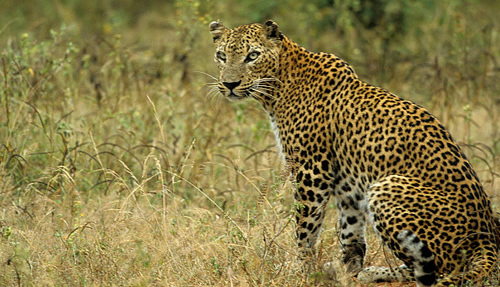
 Leopard (Panthera pardus kotiya)

Spotted Deer


In Wilpattu National Park, a number of wild species are found. There are about 31 species of mammals those are found in Wilpattu National Park. The commonly found reptiles in the Wilpattu National Park are common cobra, mugger crocodile, rat snake etc. Star tortoises, soft shelled turtles and pond turtles are also found in this national park. Many species of birds like whistling teal, spoonbill, large white egret, pin tail, white ibis, purple heron etc are seen here.
In Wilpattu National Park mainly salt grass, low scrub and monsoon forests are found. This national park is spotted with innumerable lakes. About 60 lakes have formed across the entire Wilpattu National Park. This area receives about 1000 mm of rain annually and the average annual temperature is about 27.2 Celsius.

Willuwa (Wet Land)


The Wilpattu National Park and its surrounding are steeped in history and covered with legend.Popular legend says that in 543 BC King Vijaya landed at Kudrimalai and that he married Kuweni. According to some ancient ruins identified, it is said that Kuweni lived in the place now identified as the Kali Villu. Both Kudrimalai and Kali Villu are found in the Wilpattu. Furthermore history shows that Prince Saliya, son of King Dutugemunu, lived with Asokamala in Maradanmaduwa in Wilpattu over 2000 years ago. Pomparippu too is of historical value as urns containing the remains of those belonging to pre Vijayan times have been excavated from that site. Also between Palangaturai and Kollankanatte are the remains of an old harbour.  In 1905, the designated area in Wilpattu was declared a sanctuary. Thereafter it was upgraded to national park status on February 25, 1938.


View Larger Map
 
Source - Click Here

Related Posts Plugin for WordPress, Blogger...

 
Google Analytics Alternative