Wild Life

Feel the wondering variety of wild life and bio diversity in this little island

Surfing

Arugam Bay in east cost of Sri lanka is the one of best places in earth for surfing.

White Water Rafting

The small town of Kitulgala in the hill country is the most famous whitewater rafting location in Sri Lanka.

Goldi Sand Beaches

Experience the Miracle Beaches

Cultural Events

Kendy Perahara

Showing posts with label Colombo. Show all posts

Tuesday, December 11, 2012

National Museum of Colombo


National Museum of Colombo
The Colombo Museum as it was called at the beginning was established on 1st January 1877. It founder was Sir William Henry Gregory, the British Governor of Ceylon (Sri Lanka) at the time.

The Royal Asiatic Society (CB) was instrumental in bringing to the notice of Gregory on his appointment as Governor in 1872 the need for a public museum with much difficulty the approval of the legislative council was obtained within a year. The Architect of the Public Works Department, J.G. Smither was able to prepare the plans for new structure on Italian architectural style. The construction was completed in 1876 and the Museum commenced it functions in the following year.

The Authorities of the museum took various steps to display the cultural and natural heritage of the country for this purpose.

With the development of the museum to international level, it earned the status of a national museum during the period of Dr. P. E. P. Deraniyagala. He was able to open up branch museums in Jaffna, Kandy and Ratnapura and a full - fledged Department of National Museums was established in 1942 under the act No. 31. The extension of the number of branch museums has now increased to nine and in addition a school science programme and a mobile museum service are also in operation.

History

The Colombo museum as it was called at the beginning was established on 1 January 1877. It founder was Sir William Henry Gregory the British Governor of Ceylon (Sri Lanka) at the time. The Royal Asiatic Society (CB) was instrumental in bringing to the notice of Gregory on his appointment as Governor in 1872 the need for a public Museum with much difficulty the approval of the legislative council was obtained within a year. The Architect of the Public Works Department, J. G. Smither was able to prepare the plans for new structure on Italian Architectural style. The construction was completed in 1876 and the Museum commenced it functions in the following year.
The construction of the Museum was carried out by Arasi Marikar Wapchie Marikar (born 1829, died 1925, aka Wapchi Marikar Bass, who was descended from the Sheiq Fareed family who arrived in Ceylon in 1060 AD), paternal grandfather of Sir Razik Fareed, Kt., JPUM, OBE, MP (born, 29 December 1893, died 23 August 1984). Wapchi Marikar Bass was the builder of the General Post Office in Colombo, Colombo Customs, Old Town Hall in Pettah, Galle Face Hotel, Victoria Arcade, Finlay Moir building, the Clock Tower, Batternburg Battery and many other buildings that are still standing today (2011). The Old Town Hall in Pettah, which is now a busy market, was built on a contract for the sum of 689 Streling Pounds.
In January 1877, the completed building of the Colombo Museum was declared open by His Excellency, Governor Gregory, in the presence of a large crowd, amongst which there were many Muslims present. At the end of the ceremony, His Excellency asked Arasi Marikar Wapchi Marikar what honour he wished to have for his dedication. The same question was asked by His Excellency from the carpenter who assisted Wapchi Marikar with the wood work of the Museum who desired a local Rank and was honoured accordingly. Wapchi Marikar, noticing the large number of Muslims present, feared that they would spend their time at the Museum on Friday during the Islamic congregation prayer, and requested that the Museum be closed on Fridays. This request has been adhered to by all authorities in charge of the Museum to this day.
When the throne of the last Kandyan King was to be exhibited at the Museum, the then Prime Minister, Mr. D.S.Senanayake, obtained the consent of Sir Razik Fareed, Wapchi Marikar’s grandson, to keep the Museum open on the intervening Fridays only.
During the period between 1877 and 1999, the authorities of the museum took various steps to display the cultural and natural heritage of the country for this purpose. Several other wings were added from time to time under the direction of Dr. Arthur Willey and Dr. Joseph Pearson new structures were built during the period of Dr. P. E. P. Deraniyagala, Dr. P. H. D. H. de Silva and Sirinimal Lakdusinghe. One of the natural history museum, and yet another consists of the auditorium. These buildings would facilitate the extension of the library ethnological and Anthropological studies, etc.
With the development of the museum to international level, it earned the status of a national museum during the period of Dr. P. E. P. Deraniyagala. He was able to open up branch museums in Jaffna, Kandy, and Rathnapura and a full – fledged department of national museum was established in 1942 under the act No. 31. The extension of the number of branch museums has now increased to nine and in addition a school science programme and a mobile museum service are also in operation.
The installation of the crown jewels and the throne of the last King of Kandy which were handed over back to Sri Lanka by the British Government, has greatly enhanced the quality of the museum collection. In spite of the enormousness of the various collections thematic arrangement of the galleries has provided and opportunity to visitors to study the ancient culture of the Sri Lanka under one roof. This process has further been improved by the arrangement of the galleries of the ground floor in a historical sequence and those of the upper galleries on a thematic basis.
Along with the Colombo National Museum, a library was also established on 1 January 1877. The government Oriental library (1870) was incorporated in to Colombo National Museum library, and served as the nucleus of the library collection by collecting the local publications during the past 129 years; the library has been functioning as an unofficial national library in Sri Lanka; became the first legal Deposit library in the Island. This resulted in the accumulation of a valuable collection of materials pertaining to Sri Lanka. From its inception, special attention has been given to building up of a collection related to Sri Lanka, Orientation and Natural Science.


Source - Click here

Friday, July 13, 2012

Diyawanna Oya walking track & Street Paintings

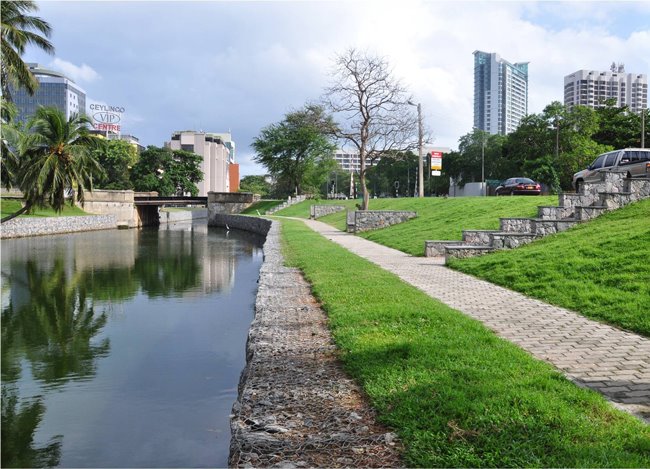
The Diyawanna Oya walking track, an area for jogging and exercising was declared officially opened for the use of the public by Chamal Rajapaksa, Speaker of the Parliament.
The programme was initiated under the Colombo City Development project with the support of the Ministry of Defence and Urban Development Authority.

The large parking lot adjacent to Diyawnna Oya made it easy to access this beautiful, free spectacle. Along the length of the promenade, people were spoilt for choice when it came time for a breather, with ample number of benches facing the rippling stream. And yet, some preferred to lie in the cool grass or laze on the large stone stairwell that led down to the water's edge.
As dusk fell canoes took to the water to merge with the sunset silhouettes. The constant breeze kept those sail boats speckling the river conjuring images of a Venetian postcard and everywhere I looked was a blend of the elements graced with a vibe of placidity... a truly amazing symphony of the environment.
In poetic praises, also referred to as sandesa kavi of the 15th Century AD, relayed stories that commended booming agriculture, towns and their economies, especially of those thriving in and around the Diyawanna Oya, of the Kotte Kingdom. The poets were usually monks from the Kingdom's many temples and their kavi or poetic messages were sent to the kings via birds. It is said that the Kotte Kingdom, among many other reasons, was praised as such as it was blessed with the protection and viable advantages of the Oya. Even today, that much is true.
One could call this the green zone, it was lush with greenery for one thing, and it was amidst a bustling town. People needed this, it was a quintessential setting, and folks came here for refreshment, to simplify the challenges of the mundane. The nurturing combination of the water, the walkway, the trees, the grass and the pedestrian crossing takes you from busy to benevolent.

Recent developments have made the area around this part of the Oya what it is now with the river's perimeter cleared of brush and widened for quite a breathtaking view of the water. The space, symbolically welcomes the discerning.
You could say that life is good for the city-dwellers as they can actually have a balance of both worlds. Just as one would head-off to the nearest ocean getaway at Galle Face Green, Diyawanna Oya could be the destination for a stroll by the riverside or even a river-boat ride. The Oya was fast gaining popularity no doubt.
Kotte, although the capital city of Sri Lanka, was lesser known for its ‘fun' aspect than that of its commercial counterpart, Colombo. However, for a city seriously bound to its official surroundings, such as the Parliament building amongst others, this new laidback space around Diyawanna Oya is what turns the tables.
It was easy to forget the extremely busy main road that ran right beside the streamlined rampart or school or even the office hours that hung on the brink of a fast-ending weekend.


Source - Click here


Wednesday, March 7, 2012

Sri Lanka, The best country in South Asia to visit - Travel Asia Online

Travel Asia Online in an exclusive report has categorized Sri Lanka as the best country in South Asia to visit, while Maldives took second place and Bhutan third. The Travel Asia Online ranks the eight south Asian countries, Afghanistan, Bangladesh, Bhutan, India, Maldives, Nepal, Pakistan and Sri Lanka in terms of their Population density, GDP Per capita, Literacy rate , Life expectancy and the Cleanliness. For every level Travel Asia Online selected top 5 countries and gave marks for them 1-5.
The Population density (people per sq. km) in Sri Lanka was reported at 308.4/km2, according to the report.
Sri Lanka (1296 US dollars) is the second highest in the list of GDP Per capita of these 8 south Asian countries and received the mark 4 out of 5. Bhutan ranked first with Maldives ranking 3rd, while India at the 4th place.
The report states that Sri Lanka’s literacy rate is 90.8 which is the second highest in the region while Maldives took first place.
Sri Lanka has topped the Life expectancy (72.4) list by recording the highest Life expectancy in the region receiving the mark 5. Sri Lanka also ranked as the best cleanest country in the region. Following the four main important facts about 8 South Asian countries, Travel Asia Online calculated the marks and gave marks out of 20. According to Travel Asia Online marks system and international statistics, Sri Lanka got 18 marks out of 20, while Maldives got 17 out of 20 and Bhutan got 11 marks out of 20.
India ranked fourth in the list.

Source - Sunday Times

Saturday, February 18, 2012

Visit Miracle Colombo 2012


Colombo is the largest city and former administrative capital of Sri Lanka. Colombo is located on the west coast of the island and adjacent to Sri Jayawardenepura Kotte, the present administrative capital of Sri Lanka. Colombo is a busy and vibrant city with a mixture of modern life and colonial buildings and ruins.

The name "Colombo", first introduced by the Portuguese in 1505, is believed to be derived from the classical Sinhalese name Kolon thota, meaning "port on the river Kelani". It has also been suggested that the name Colombo may be derived from the Sinhalese name Kola-amba-thota which means "Harbour with leafy mango trees".

Due to its large harbour and its strategic position along the East-West sea trade routes, Colombo was known to ancient traders 2,000 years ago. However it was only made the capital of the island when Sri Lanka was ceded to the British Empire in 1815, and its status as capital was retained when the nation became independent in 1948. In 1978, when administrative functions were moved to Sri Jayawardenepura Kotte, Colombo was designated as the commercial capital of Sri Lanka.
This is some of pictures of up growing Colombo city in 2012.

Click on the picture to larger view


 Sky Scrapers


 Old Parliment


Clean Streets of the City


Nelum Pokuna Performing Arts Theatre


 New look of Berei Lake


Related Posts Plugin for WordPress, Blogger...

 
Google Analytics Alternative