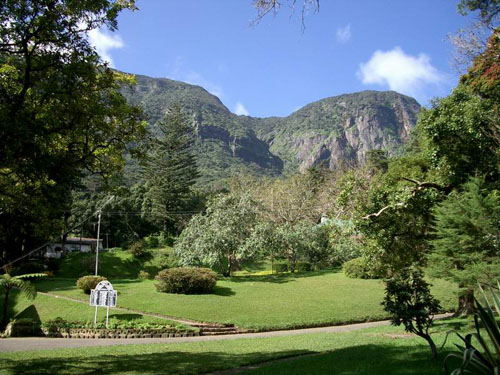
Sri Lanka's first-ever botanical gardens in the dry zone, soon to be the largest in the island, is now being developed at a 300-acre site at Mirijjawila, Hambantota. On the Suriyawewa-Hambantota Road, the Gardens is aimed at conserving the massive green patch and bio diversity in the area, according to National Botanical Gardens Department Director General Dr. Cyril Wijesundara.
He told the Business Times that this space will be like Central Park in New York, on completion, and pave the way to attract both domestic and foreign tourists to this southern town, fast turning out to be a hub of the south with the development of air and seaports and other facilities. This is the country's first new botanical gardens built in Sri Lanka in 130 years after the Senarathgoda Garden in Gampaha in 1876, and the Peradeniya Gardens long before that.
The first phase of the Hambantota project will be completed in November this year at a cost of Rs.500 million. Construction work of the internal roads underground pipe lines, irrigation canals and plant nurseries has been completed and the planting of trees like burutha (Burma teak), domba, ehela, gammalu, hal milla, helamba ingini, kaluwara, khomba, kon, kottamba, etc is now underway.The park will be opened to the general public next year. The main purpose of the new gardens is to showcase dry and arid zone plants (ex-situ conservation). The garden will also provide opportunities for ecotourism and economic development in the area and model dry zone landscape improvement.
Dr. Wijesundara noted that the new botanical gardens will provide for the conservation of dry and arid zone flora. Additionally, researchers and interested parties would be able to study less known and under-utilized plants in the dry zone. "When it comes to a tourist attraction, foreign tourists especially are keen on learning about the dry zone landscape improvement, herbal industry promotion etc.
Moreover the botanical gardens will be an educational and training centre of Botany and flora," he said. Experience of running the national botanic gardens of Peradeniya and Hakgala has demonstrated the business case for tourism, with both gardens being profitable. The new Dry Zone Garden will follow this established, and tried and tested pattern, he said.
Dr. Wijesundara said that the new gardens will be an educational resource for educational institutions of all levels, from junior school through to higher education. The gardens will also be a source of expertise, particularly in the long term where diploma courses and other formal educational provision in Floriculture and Herbal industries will become more important - and popular - within the educational curriculum.
Future courses in biodiversity and conservation will also benefit from having a national resource to draw upon, a location for student volunteers (national and international programme potential) and a place where research projects can be carried out too, he said.
The herbal industry will be supported as the gardens will hold a specialized herb collection. The dry zone has a large number of medicinal plants that are used in Sri Lanka presently. Dr. Wijesundara said that these are valuable plants which can be used in the development of the herbal industry, one of the fastest growing industries in other countries in this region.
The gardens will become a centre for the promotion of the herbal industry; one which can be sustainable in the future is managed well today. Another area of plant based industries is production of bio-fuel.


Source - Sunday Times
He told the Business Times that this space will be like Central Park in New York, on completion, and pave the way to attract both domestic and foreign tourists to this southern town, fast turning out to be a hub of the south with the development of air and seaports and other facilities. This is the country's first new botanical gardens built in Sri Lanka in 130 years after the Senarathgoda Garden in Gampaha in 1876, and the Peradeniya Gardens long before that.
The first phase of the Hambantota project will be completed in November this year at a cost of Rs.500 million. Construction work of the internal roads underground pipe lines, irrigation canals and plant nurseries has been completed and the planting of trees like burutha (Burma teak), domba, ehela, gammalu, hal milla, helamba ingini, kaluwara, khomba, kon, kottamba, etc is now underway.The park will be opened to the general public next year. The main purpose of the new gardens is to showcase dry and arid zone plants (ex-situ conservation). The garden will also provide opportunities for ecotourism and economic development in the area and model dry zone landscape improvement.
Dr. Wijesundara noted that the new botanical gardens will provide for the conservation of dry and arid zone flora. Additionally, researchers and interested parties would be able to study less known and under-utilized plants in the dry zone. "When it comes to a tourist attraction, foreign tourists especially are keen on learning about the dry zone landscape improvement, herbal industry promotion etc.
Moreover the botanical gardens will be an educational and training centre of Botany and flora," he said. Experience of running the national botanic gardens of Peradeniya and Hakgala has demonstrated the business case for tourism, with both gardens being profitable. The new Dry Zone Garden will follow this established, and tried and tested pattern, he said.
Dr. Wijesundara said that the new gardens will be an educational resource for educational institutions of all levels, from junior school through to higher education. The gardens will also be a source of expertise, particularly in the long term where diploma courses and other formal educational provision in Floriculture and Herbal industries will become more important - and popular - within the educational curriculum.
Future courses in biodiversity and conservation will also benefit from having a national resource to draw upon, a location for student volunteers (national and international programme potential) and a place where research projects can be carried out too, he said.
The herbal industry will be supported as the gardens will hold a specialized herb collection. The dry zone has a large number of medicinal plants that are used in Sri Lanka presently. Dr. Wijesundara said that these are valuable plants which can be used in the development of the herbal industry, one of the fastest growing industries in other countries in this region.
The gardens will become a centre for the promotion of the herbal industry; one which can be sustainable in the future is managed well today. Another area of plant based industries is production of bio-fuel.


A group of school children walk through the unfinished Botanical Gardens when they attended a recent workshop on biodiversity for AL students in the area. Resource persons at the workshop were Samantha Gunasekara (Customs Dept.), Jagath Gunawardena (Environmentalist), Anslem de Silva (Reptile expert) and Upali Ekanayake (Bird expert). Pic courtesy Dept. of National Botanical Gardens.
Source - Sunday Times